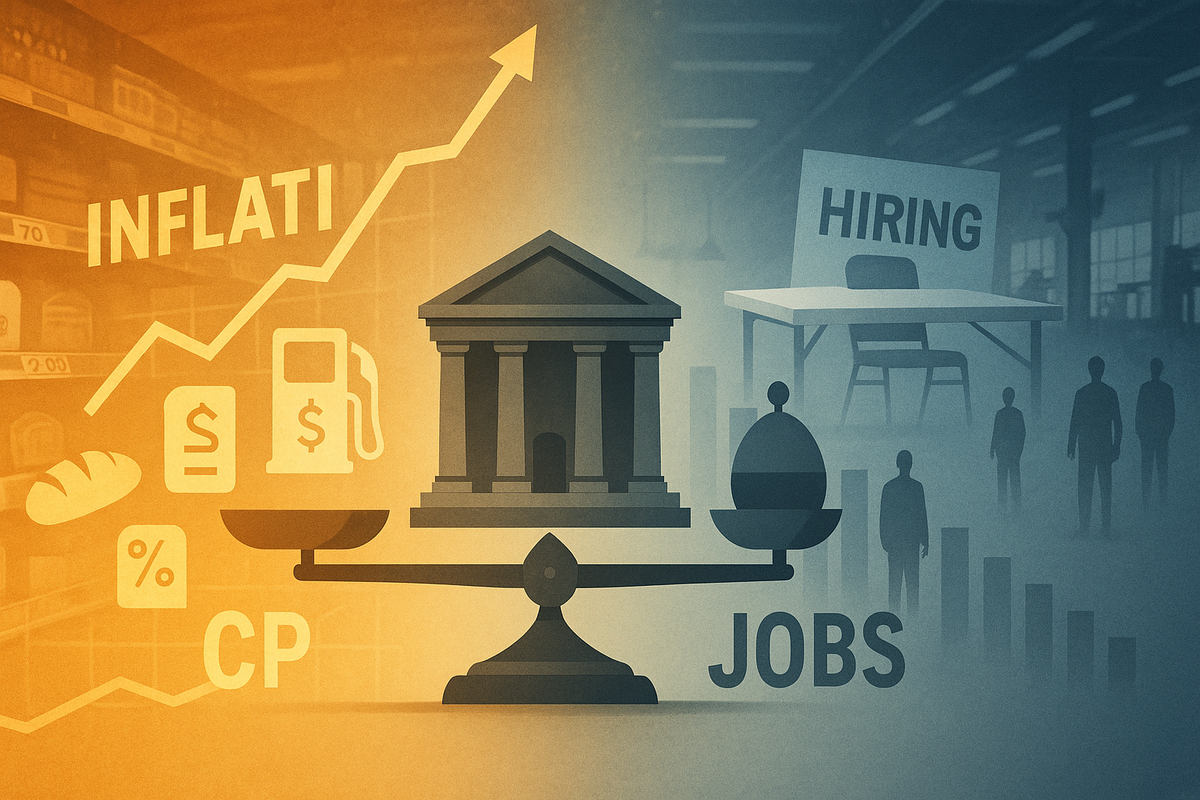
In the grand, marbled halls of the Eccles Building in Washington D.C., the most powerful economic institution in the world, the Federal Reserve (the Fed), is engaged in a high-stakes performance. Its task is a delicate and perilous balancing act, the likes of which hasn’t been seen since the early 1980s. On one side is the persistent threat of high inflation, which erodes the purchasing power of American households and destabilizes the economy. On the other is the very real risk of recession, a downturn that could throw millions out of work and cascade into a deeper crisis.
This is the “soft landing”—the holy grail of central banking. It describes the process of tightening monetary policy just enough to cool down an overheated economy and bring inflation back to the Fed’s 2% target, but without applying so much brake that the economy stalls completely and plunges into a recession. For over a year, the Fed has been aggressively raising interest rates, the most potent tool in its arsenal, in an attempt to achieve this outcome. The question on the minds of economists, investors, and everyday Americans is: Can they pull it off?
This article will dissect the Fed’s monumental challenge. We will explore the origins of the current inflationary surge, the mechanics and impact of the Fed’s policy tools, the historical precedents for a soft landing, and the significant headwinds that make today’s economic environment uniquely complex. Our analysis is grounded in economic data, historical context, and the stated guidance of the Federal Reserve itself, providing a comprehensive and authoritative overview of this critical moment in US economic history.
Part 1: The Inflationary Inferno – How We Got Here
To understand the Fed’s current dilemma, one must first appreciate the perfect storm that fueled the highest inflation in 40 years. This was not a simple case of an economy running too hot; it was a confluence of unprecedented factors.
1.1 Pandemic-Driven Demand Shock
The COVID-19 pandemic triggered a massive and sudden shift in consumer spending. With services like travel, dining, and entertainment shut down, household disposable income, bolstered by expansive fiscal stimulus (e.g., the CARES Act), flooded into goods. Americans bought new homes, renovated existing ones, and filled them with appliances, electronics, and furniture. This surge in demand for physical goods strained global supply chains that were simply not built for such a pivot.
1.2 Supply Chain Carnage
Simultaneously, the supply side of the equation was breaking down. Factory closures, port congestion, and a critical shortage of shipping containers created monumental bottlenecks. The just-in-time global manufacturing model, efficient in stable times, proved incredibly fragile. The time and cost to ship a container from Asia to the US skyrocketed, embedding higher costs into a vast range of products.
1.3 Labor Market Tightness
The post-pandemic labor market recovery was remarkably rapid, but it became extremely tight. A combination of early retirements, health concerns, and shifting work-life preferences led to a significant drop in labor force participation. With demand for workers soaring, businesses were forced to compete for a limited pool, driving wages higher—a key factor in service-sector inflation. While wage growth initially lagged behind inflation, it began to run at a pace inconsistent with the Fed’s 2% inflation target.
1.4 Energy and Geopolitical Shock
Just as the global economy began to normalize, Russia’s invasion of Ukraine in February 2022 sent another seismic shock through the system. The war disrupted global supplies of key commodities, sending the prices of oil, natural gas, and wheat to multi-year highs. This not only increased the cost of energy and food directly for consumers but also raised production and transportation costs for virtually all industries, adding another persistent layer of inflation.
1.5 The Fed’s “Behind the Curve” Moment
In hindsight, many economists and the Fed itself have acknowledged that policymakers were initially too slow to react. They initially characterized the inflation surge as “transitory,” believing it would quickly recede as pandemic-related disruptions resolved. This perception, combined with a longstanding focus on maximizing employment, meant the Fed kept monetary policy highly accommodative for too long, allowing inflationary psychology to become entrenched.
Part 2: The Fed’s Toolkit – Raising Rates and Quantitative Tightening
Once the persistence of inflation became undeniable, the Fed embarked on one of the most aggressive tightening cycles in its history. Its primary tools are interest rate policy and balance sheet management.
2.1 The Federal Funds Rate: The Primary Brake Pedal
The federal funds rate is the interest rate at which depository institutions lend reserve balances to other depository institutions overnight. It is the primary benchmark for short-term interest rates in the US.
- How it Works: By raising this rate, the Fed makes borrowing more expensive for everyone. Banks pass on higher costs to consumers and businesses through increased rates on mortgages, auto loans, credit cards, and business loans.
- The Intended Effect: This cools demand. Expensive mortgages slow the housing market. Costlier car loans reduce auto sales. Higher rates on business investments discourage expansion and hiring. The goal is to reduce overall spending in the economy, bringing it back into balance with supply and thus relieving inflationary pressures.
Since March 2022, the Fed has raised the federal funds rate from a baseline of 0-0.25% to a target range of 5.25%-5.50%, the highest level in over 22 years.
2.2 Quantitative Tightening (QT): Siphoning Off Liquidity
During the financial crisis of 2008 and the COVID-19 pandemic, the Fed engaged in Quantitative Easing (QE)—buying trillions of dollars in Treasury bonds and mortgage-backed securities (MBS) to inject liquidity into the economy and suppress long-term interest rates.
QT is the reverse process. The Fed is now allowing up to $60 billion in Treasury bonds and $35 billion in MBS to mature each month without reinvesting the proceeds. This slowly reduces the size of its massive $7.5 trillion balance sheet.
- How it Works: By not reinvesting, the Fed effectively removes liquidity from the financial system. This puts upward pressure on long-term interest rates, further tightening financial conditions. It’s a more subtle tool than rate hikes but works in concert with them to cool the economy.
Part 3: The Transmission Mechanism – How Policy Filters Through the Economy
The Fed’s actions do not work instantaneously. They operate with “long and variable lags,” a concept famously highlighted by Milton Friedman. It can take 12 to 18 months for the full effect of a rate hike to be felt across the economy. This transmission occurs through several key channels:
3.1 The Interest-Sensitive Sectors: Housing and Durables
The most immediate impact is felt in sectors that rely heavily on financing. The US housing market has been a clear casualty. The average 30-year fixed mortgage rate more than doubled from its lows, leading to a dramatic slowdown in home sales, a cooling of price growth, and a sharp pullback in home construction. Similarly, demand for big-ticket items like cars and appliances, often purchased on credit, has softened.
3.2 The Financial Conditions Channel
Higher interest rates tighten overall financial conditions. Stock markets often reprice as future corporate earnings are discounted at a higher rate. Corporate bond yields rise, making it more expensive for companies to raise capital. This can lead to a pullback in investment, mergers and acquisitions, and hiring.
3.3 The Exchange Rate Channel
Higher US interest rates attract foreign investment, increasing demand for the US dollar. A stronger dollar makes US exports more expensive for other countries, potentially hurting US manufacturers and farmers. However, it also makes imports cheaper, which can help dampen inflationary pressures by reducing the cost of imported goods.
3.4 The Psychological Channel (Managing Expectations)
Perhaps the most critical channel is psychological. The Fed’s credibility is its most valuable asset. If businesses and consumers believe the Fed is committed to fighting inflation, they will adjust their behavior accordingly—workers may moderate wage demands, and companies may think twice about aggressive price hikes. This prevents a 1970s-style “wage-price spiral” from becoming entrenched. The Fed’s forward guidance and unwavering rhetoric are key tools in shaping these expectations.
Part 4: The Recession Risk – What Could Go Wrong?
The very mechanism the Fed is using to fight inflation is also the one that could trigger a recession. The risks are multifaceted and significant.
4.1 Overtightening: The Primary Danger
The biggest risk is that the cumulative effect of rate hikes and QT proves too powerful for the economy to withstand. The “long and variable lags” mean the Fed is driving a car by looking in the rearview mirror; they are making decisions based on economic data from months ago, while the full impact of their past hikes is still in the pipeline. By the time they see clear evidence of a sharp slowdown, it may be too late to avoid a contraction.
4.2 The Labor Market Conundrum
The US labor market has remained surprisingly resilient despite the Fed’s actions. Unemployment has hovered near multi-decade lows. While this is good news for workers, from the Fed’s perspective, it signals an economy that may still be running too hot. If wage growth continues at its current pace, it could sustain inflation in the services sector, which is less sensitive to interest rates. The Fed may feel compelled to raise rates further or hold them high for longer, increasing the odds of a sharp rise in unemployment later.
4.3 External Shocks and Banking Stress
The global economy is fragile. A deeper recession in Europe or a continued slowdown in China could hurt US exports. Furthermore, the rapid rise in interest rates has exposed vulnerabilities in the financial system, as seen in the regional banking crisis of March 2023 (Silicon Valley Bank, Signature Bank). Higher rates have eroded the value of long-dated bonds held by banks, potentially making them susceptible to bank runs and creating a credit crunch where banks tighten lending standards sharply, an accelerant for recession.
4.4 The “Last Mile” Problem
Recent data has shown inflation cooling from its peak of 9.1% in June 2022. However, the final push down to the Fed’s 2% target may be the most difficult. Core inflation (which excludes volatile food and energy prices) has proven sticky, driven by persistent strength in shelter costs and services. Squeezing out this last bit of inflation may require a level of economic slack—i.e., higher unemployment—that is inherently recessionary.
Read more: 5 Critical Reasons Why the Fed’s Next Rate Move Matters (2025 Guide)
Part 5: The Case for a Soft Landing – Glimmers of Hope
Despite the significant risks, there is a plausible scenario where the Fed succeeds. Several factors provide grounds for cautious optimism.
5.1 A Resilient and Adaptive Economy
The US economy has repeatedly defied predictions of an imminent recession. Consumer balance sheets, while weakening, are still relatively healthy compared to pre-pandemic levels, having been bolstered by savings and stimulus. Corporate balance sheets are also generally strong. This underlying resilience could allow the economy to absorb the Fed’s tightening without breaking.
5.2 Easing Supply-Side Pressures
Many of the supply-side drivers of inflation have normalized. Global supply chains have largely untangled, shipping costs have plummeted, and commodity prices have retreated from their peaks. This disinflationary impulse is helping the Fed’s cause, meaning it may not have to crush demand as aggressively as it once thought.
5.3 The Fed’s Data-Dependent Approach
Fed Chair Jerome Powell has repeatedly emphasized that the Fed is no longer on a pre-set path and will be “data-dependent.” This flexibility allows them to slow the pace of hikes, pause, or even pivot if the data shows the economy is cooling rapidly. Their decision in late 2023 to slow the pace of hikes and eventually hold rates steady demonstrates this cautious approach, reducing the risk of a policy error from overtightening.
5.4 Historical Precedent: 1994-1995
While rare, soft landings have been achieved. The most famous example is under Fed Chair Alan Greenspan in 1994-1995. The Fed doubled the federal funds rate from 3% to 6% to head off inflation, and while growth slowed, the US avoided a recession. The current Fed is undoubtedly studying this playbook, though the starting inflation level today is much higher.
Conclusion: The Delicate Dance Continues
The Federal Reserve’s balancing act is far from over. It has made significant progress in reducing inflation from its scorching peak, but the final descent to 2% is fraught with risk. The economy is sending mixed signals: a cooling housing market but a resilient labor force; slowing inflation but persistent price pressures in services.
The path to a soft landing is narrow, and the margin for error is slim. The Fed must continue to walk a tightrope, calibrating its policy with precision and care. It must remain resolute enough to restore price stability—the bedrock of a healthy economy—while being nimble enough to recognize the first signs of an undue downturn.
For the American public, this means bracing for a period of continued economic uncertainty. The era of near-zero interest rates is likely over. The cost of borrowing will remain high, and the job market may soften. Yet, the alternative—allowing high inflation to become a permanent feature of the economy—would be far more painful in the long run. The success or failure of the Fed’s high-wire act will define the US economic trajectory for years to come.
Read more: What Happens If the Fed Holds Rates Higher for Longer?
Frequently Asked Questions (FAQ)
1. What exactly is a “soft landing” and has the Fed ever achieved one before?
A soft landing occurs when a central bank successfully slows an economy enough to curb inflation without causing a recession. It is very difficult to achieve. The most cited successful example is from 1994-1995 under Fed Chair Alan Greenspan. The Fed raised rates preemptively, growth moderated, and the economy continued to expand without a downturn.
2. Why does the Fed target 2% inflation? Why not 0% or 3%?
A 2% inflation rate is seen as a “goldilocks” zone. It is low enough to allow households and businesses to plan for the future without significant erosion of purchasing power. It also provides a buffer against deflation (falling prices), which can be even more damaging, causing consumers to delay purchases and leading to a downward economic spiral. A small, positive inflation rate also gives central banks more room to cut real interest rates during a downturn.
3. How do higher interest rates actually lower inflation?
They work by reducing demand across the economy. When it’s more expensive to borrow money for a house, a car, or a business expansion, people and companies spend less. This reduction in spending helps bring the economy’s overall demand back in line with its supply capacity, which relieves the upward pressure on prices.
4. I keep hearing about “core inflation.” What is it, and why does the Fed focus on it?
Core inflation is a measure that excludes the volatile food and energy sectors. Food and energy prices can swing wildly based on weather, geopolitics, and other temporary factors that monetary policy cannot influence. By focusing on core inflation, the Fed gets a better sense of the underlying, persistent trend in inflation that is driven by domestic demand and wage growth.
5. What is the difference between a recession and a depression?
A recession is a significant decline in economic activity that lasts for more than a few months, typically visible in real GDP, real income, employment, industrial production, and wholesale-retail sales. A common rule of thumb is two consecutive quarters of negative GDP growth. A depression is a much more severe and prolonged downturn, lasting for years and characterized by extreme unemployment and a collapse of credit and trade. The Great Depression of the 1930s is the prime example.
6. What can I do to protect my finances in this uncertain environment?
- Review Your Budget: Inflation and higher rates mean your money doesn’t go as far. Scrutinize your spending and prioritize essentials.
- Tackle High-Interest Debt: Credit card and variable-rate debt becomes more expensive. Focus on paying it down.
- Build an Emergency Fund: Aim for 3-6 months of living expenses in a high-yield savings account to weather potential job loss or unexpected costs.
- Be Cautious with Investments: Ensure your investment portfolio is aligned with your risk tolerance and time horizon. Market volatility is likely to continue.
- Avoid Major, Impulsive Financial Decisions: This is not a typical economic cycle. Prudence and caution are advisable.
About the Analysis: This article synthesizes data from the Federal Reserve Board, the Bureau of Labor Statistics (BLS), the Bureau of Economic Analysis (BEA), and analysis from a range of respected financial and economic institutions. It is intended for informational purposes and should not be considered financial advice. For personalized guidance, please consult with a qualified financial advisor.