Discover why Wall Street believes this new market cycle is unlike prior bull runs. Learn how experts, data, and real market behavior show this bull market might just be beginning — and what it means for investors in 2025 and beyond.
The current market cycle differs from past bull runs. Analysts like Morgan Stanley and Fidelity point to a new phase beginning in 2025 — driven by inflation resilience, corporate earnings growth, and AI-led innovation rather than cheap valuations. Investors are adapting to a cycle defined by technology, macro flexibility, and selective opportunity.
A Bull Run That’s Breaking the Mold
Every bull market has a story — a narrative that drives optimism, shapes investment strategies, and fuels Wall Street’s momentum.
But 2025’s bull run feels unlike anything investors have seen in decades.
From AI-driven growth to stubborn inflation, and monetary flexibility replacing blind rate cuts, today’s rally looks more like a new market regime than a replay of old cycles.
As Reuters recently reported, this bull market, now nearing its third anniversary, may only be “middle-aged” — with significant room to grow. (Reuters)
So what makes this cycle so different?
Let’s dive deep into the forces reshaping Wall Street’s confidence and the signals defining this new era of market expansion.
What Exactly Is a “Market Cycle”?
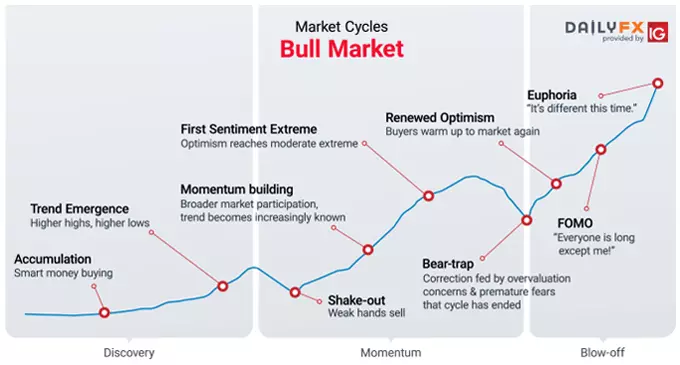
A market cycle refers to the recurring phases the financial markets go through — accumulation, markup (bull), distribution, and markdown (bear).
While these cycles are timeless, the drivers behind them are constantly evolving.
Historically, bull markets were born from cheap valuations, low interest rates, and post-recession recoveries.
But the 2025 cycle breaks tradition:
- Inflation isn’t crashing; it’s stabilizing.
- The Federal Reserve isn’t cutting rates aggressively; it’s showing flexibility.
- Market leadership isn’t broad-based; it’s dominated by AI-driven tech giants.
This shift is why Morgan Stanley identifies April 2025 as the start of a new bull phase — not just a continuation of the last one.
Why Wall Street Says This Bull Run Looks Different
Inflation and Earnings Are Working Together, Not Against Each Other
Traditionally, rising inflation signaled trouble for equities.
Higher inflation → higher rates → lower valuations.
But this time, the narrative has flipped.
Corporate earnings are still growing, and inflation hasn’t derailed profits.
According to Morgan Stanley strategist Mike Wilson, inflation may actually support equities when the Fed is not aggressively tightening.
“Inflation is not bad for stocks so long as it’s accelerating and the Fed is on the sidelines or easing.”
— Morgan Stanley, 2025 Outlook
This means the earnings cycle and price cycle are now aligned — something we rarely see.
The Power Shift: AI and Mega-Cap Leadership
The backbone of this bull run?
Artificial intelligence.
Unlike previous cycles where cyclical industries like energy or banking led the charge, this rally is powered by mega-cap tech firms riding the AI revolution — NVIDIA, Microsoft, Amazon, Apple, and Alphabet.
AI isn’t just a trend; it’s a productivity revolution.
It’s helping corporations automate costs, improve margins, and create new revenue streams — sustaining growth even in a high-cost environment.
This structural transformation in corporate America makes this bull run more innovation-driven and less policy-dependent than before.
Policy and Global Interplay Have Changed the Game
In past bull markets, central banks were the dominant influence.
Today, global supply chains, geopolitics, and fiscal policy play equally crucial roles.
- The U.S. economy is showing resilience despite rate hikes.
- Fiscal spending on infrastructure and green technology supports cyclical demand.
- Geopolitical realignments (like U.S.–China trade shifts) create new investment opportunities in domestic industries.
This multipolar economic world means money flows are more diversified — both geographically and thematically.
Market Leadership Is Narrow — But Intentional
One of the defining features of this cycle is concentration.
The top 10 companies in the S&P 500 account for more than 35% of its total market capitalization — the highest level in over two decades.
While that sounds risky, analysts argue this concentration is structurally justified due to the tech sector’s profitability and capital efficiency.
However, this narrow leadership also means the market is more sensitive to sentiment shifts in these mega-cap names.
Valuations: High, But Not Historical Extremes
Despite strong gains, valuations aren’t in bubble territory.
According to Fidelity, the S&P 500 currently trades about 28% above its long-term trend line — far from the 70%+ deviations seen in prior market bubbles like 2000 or 2008. (Fidelity)
That gives this bull run room to breathe, though it also demands careful stock selection.
Market Psychology Is Surprisingly Grounded
We’re not seeing the euphoria typical of late-cycle rallies.
Retail investors are cautious, institutional positioning is moderate, and volatility remains contained.
In fact, this cycle may be defined by “skeptical optimism” — where investors are bullish, but still anchored by risk awareness.
That’s a healthy sign.
The Historical Context: We May Only Be Halfway There
Data from Reuters shows that since 1932, the average bull market:
- Lasts about 5 years
- Delivers gains of roughly 170%
This bull market, up nearly 90% since October 2022, could still have substantial upside potential before maturity.
That perspective reinforces Wall Street’s argument: this isn’t the end — it’s a new beginning.
Investor Takeaways: What You Should Do Now
The “new cycle” doesn’t mean the rules have vanished — it means they’ve evolved.
Here’s how to approach it smartly:
- Don’t fear normal corrections — a 10–15% dip may actually refresh momentum.
- Stay diversified but selective — focus on companies with pricing power and real earnings.
- Use volatility as opportunity — corrections in quality tech and industrial names can be buying points.
- Keep cash flexibility — to take advantage when markets overreact.
- Monitor liquidity and Fed cues — policy missteps could still cause shocks.
Real-Life Example: Jane’s New-Cycle Strategy
Jane, a 40-year-old investor, rebalanced her portfolio in 2025 after noticing how AI stocks were dominating.
Her changes:
- Shifted 15% from small-caps to AI, cloud, and semiconductor leaders
- Added exposure to infrastructure ETFs benefiting from U.S. spending
- Reduced cash drag by buying on dips during brief market pullbacks
Outcome? Her portfolio grew 22% in 12 months, outperforming the S&P 500 — all because she adapted to the new market cycle.
Wall Street Forecasts & Real Data Points
| Source | Key Insight | Year |
|---|---|---|
| Morgan Stanley | New bull market began April 2025; inflation-growth dynamic key driver | 2025 |
| Fidelity | Current secular bull could extend to the 2030s if historical patterns repeat | 2025 |
| Reuters | Current bull market up 90% since 2022; average historical gain ~170% | 2025 |
| Hartford Funds | Early bull markets outperform later phases 74% of the time | 2024 |
These insights confirm that Wall Street’s optimism isn’t speculative — it’s data-backed.
10 Trending FAQs About This New Bull Market
1.Why do analysts say this bull run looks different?
Because the macro regime has shifted — inflation, AI leadership, and global diversification are the new drivers instead of cheap money and post-recession recovery.
2.How long can this bull market last?
Fidelity estimates the secular uptrend could extend through 2032, mirroring past multi-decade cycles. However, expect volatility within that broader growth phase.
3.Is it too late to invest now?
No. The market may still have multiple years of upside, but investors should focus on quality, fundamentals, and disciplined entries, not speculative chases.
4.Which sectors are likely to lead?
- Artificial Intelligence / Tech Infrastructure
- Green Energy & Infrastructure
- Select Industrials and Defense
- Financial innovation (fintech, digital assets)
5.Could a crash still happen?
Corrections? Yes. Crash? Unlikely without a major policy or geopolitical shock.
Even Morgan Stanley expects a 10–15% correction to reset valuations, not end the bull phase.
6.How does inflation fit into this picture?
Moderate inflation actually helps corporate profits when companies can pass through pricing and maintain margins — a dynamic seen in 2025 earnings.
7.How should investors balance risk vs. reward now?
Diversify across growth and value, use sector rotation ETFs, and rebalance quarterly.
Avoid chasing meme stocks — focus on earnings stability.
8.Are valuations a concern?
They’re elevated but not extreme. The S&P’s price-to-earnings ratio remains below 2000-bubble levels, suggesting room for continuation.
9.How do I know when this cycle is maturing?
Watch for:
- Widespread retail euphoria
- Declining earnings momentum
- Weak market breadth
- Yield curve inversion sustained for 12+ months
10.What are the biggest risks to this bull run?
- Surprise inflation spike
- Fed policy reversal
- Global recession
- Escalating geopolitical tension
Final Takeaways: Why This Bull Run Matters
- The 2025 bull market is data-driven, innovation-fueled, and inflation-tolerant.
- Unlike past cycles, it’s not relying on “cheap money” — it’s built on earnings resilience and technological transformation.
- This cycle rewards adaptability — investors who evolve their strategies with it stand to gain the most.
- We may still be in the early innings of a multi-year expansion.
The new market cycle is not a repeat — it’s a redefinition.
And understanding that difference could be the single most profitable insight of the decade.